The fastest way to spot fake gold is to check the hallmark, run a magnet test, and inspect the wear points where plating rubs through. No single test settles it alone, but stacked together they catch most fakes in minutes. I checked thousands of gold listings during my marketplace years, and the same tells show up over and over.
Start With the Hallmark, Then Distrust It
Every legitimate piece of gold jewelry sold in most markets carries a purity mark. Look inside the ring band, on the clasp tag of a chain, or on the back of a pendant. You are looking for a karat stamp like 10K, 14K, 18K, or 24K, or a fineness number like 417, 585, 750, or 999.
Those numbers map to purity. A 585 stamp means 58.5 percent gold, which is 14K. A 750 stamp means 75 percent, which is 18K. If a piece is stamped 14K but the seller calls it pure gold, someone is wrong, and it is usually not the stamp.
Now the uncomfortable part. Counterfeiters stamp fake hallmarks all the time. In my years checking listings, a crisp 750 stamp on a brass chain was one of the most common tricks I saw. Treat the hallmark as a first filter, not as proof.
Watch for the plating giveaways hiding next to the karat mark. GP means gold plated. GF means gold filled. HGE means heavy gold electroplate. A stamp like 18K GP is an honest label for a plated piece, but plenty of sellers crop it out of photos or bury it in the description. I cover more marks across my gold and jewelry guides.
The Magnet Test Takes Ten Seconds
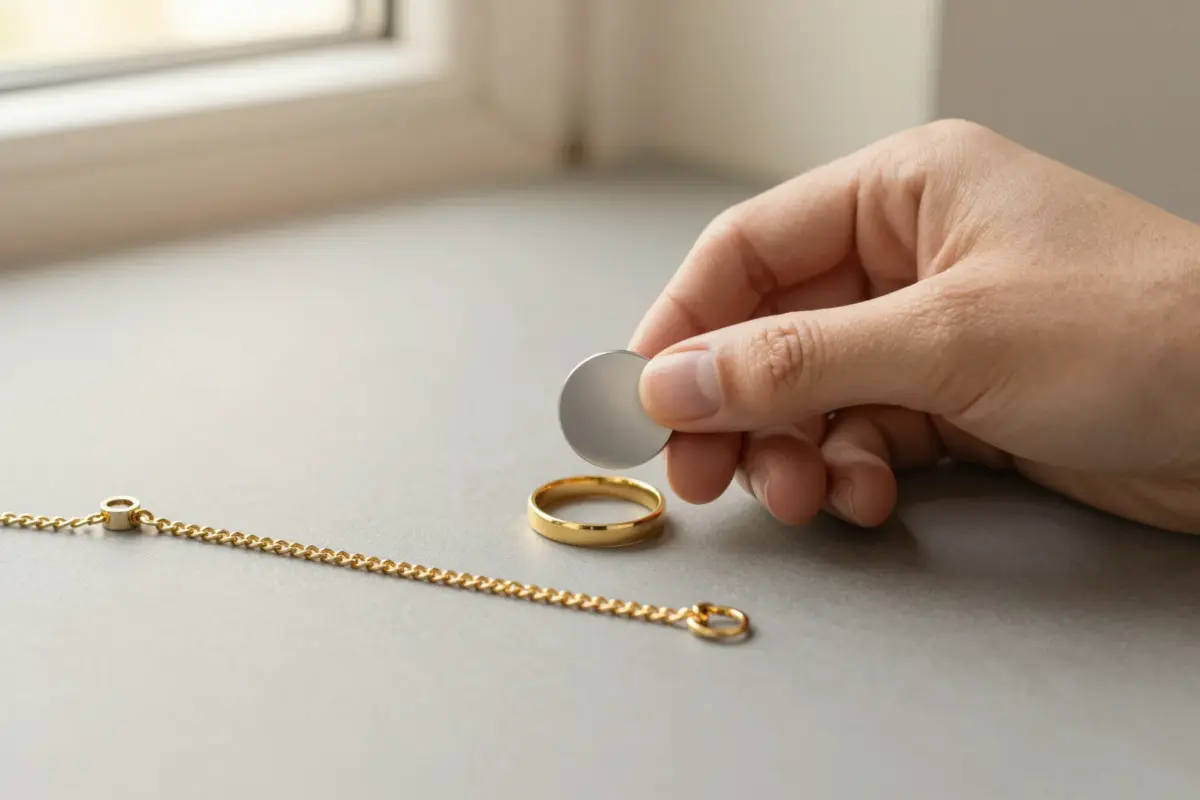
Gold is not magnetic. A strong neodymium magnet, the kind sold for a few dollars at any hardware store, gives you a fast first read on any piece.
Hold the magnet against the item. If it snaps toward the magnet or clearly pulls, there is steel or iron underneath, and the piece is not solid gold. Fridge magnets are too weak for this, so use a neodymium one.
Understand what a pass means. A piece that ignores the magnet has cleared one filter, nothing more. Brass, copper, and lead-based fakes also ignore magnets, and those are exactly the metals counterfeiters reach for. The magnet test can rule gold out. It can never rule it in.
One more catch. Clasps and springs on genuine gold chains often contain steel, so test the body of the chain, not the clasp.
Check the Wear Points
Plating wears through. Solid gold does not. This is the check I trust most on used pieces, because time has already done the work for you.
Look at the spots that rub against skin and clothing. The inside of a ring band, the edges of a pendant, the links near a chain clasp, the corners of a case back. On plated fakes you will see a duller, darker, sometimes reddish or silvery metal breaking through the gold color.
Skin evidence counts too. If the previous owner mentions the piece left green or black marks on their skin, that is copper or nickel reacting with sweat. Solid gold does not do that.
Color breakthrough is hard to judge from a listing photo, and sellers know it. This is where I point people to Legit Check, which reads these exact visual signals from your photos and returns a reasoned verdict with a confidence score in seconds.
Weight and Density Tell the Truth
Gold is one of the densest metals you will ever hold. Pure gold sits at 19.3 grams per cubic centimeter, roughly twice the density of the brass and copper alloys used in most fakes. The World Gold Council publishes the reference figures if you want to go deeper.
In hand, real gold feels heavier than its size suggests. A fake chain of the same length and thickness feels light and hollow by comparison. Once you have handled a few genuine pieces, this becomes the tell you notice first.
You can measure it properly at home. Weigh the piece on a jewelry scale, then use water displacement to find its volume, and divide weight by volume. Solid 14K should land somewhere near 12.9 to 14.5 grams per cubic centimeter depending on the alloy.
One warning for bars and coins. Tungsten has nearly the same density as gold, and tungsten-core fakes pass the density test. For bullion, density alone is never enough, so combine it with the other checks here and a professional verification before large money moves.
Photograph the item and Legit Check runs these same checks in seconds, returning a confidence score and the reasoning behind it.
The Ceramic Streak Test
An unglazed ceramic tile turns a bathroom leftover into a testing tool. Drag the piece across the rough, unglazed side with light pressure.
Real gold leaves a gold streak. Most fakes leave a black, grey, or greenish streak instead, because the base metal is doing the marking.
Be careful with this one. The test scratches, so use an edge or a spot that does not show, and skip it entirely on a piece you might return. On plated items a gentle pass can still pull gold from the surface layer, so a gold streak is weaker evidence than a black streak. A black streak is close to conclusive.
Red Flags in Online Gold Listings
Most fake gold today changes hands online, so half the battle happens before the piece ever reaches you. These are the listing patterns that made me look twice as a marketplace moderator.
Price is the loudest signal. Gold has a live spot price, and nobody sells real 18K at 70 percent below melt value. Run the math. Weight times purity times spot price gives you the floor, and a price under the floor means the gold, the weight, or the purity claim is false.
Stock photos and cropped hallmarks come next. A seller with a genuine piece photographs the stamp. A seller hiding a GP mark photographs everything except the stamp. Ask for a macro shot of the hallmark and the clasp, and walk away if they refuse.
Vague metal language is the third tell. Phrases like gold tone, gold color, or gold finish are quiet admissions that the piece is not solid gold. The same evasive patterns show up in fake watch listings, which I broke down in my fake Rolex guide.
When to Pay for a Professional Test
Home checks stack the odds in your favor, but they have a ceiling. Acid test kits give a purity read for under 20 dollars, though they scratch the piece and can misread heavy plating. An XRF scan at a jeweler or pawn shop reads the surface alloy without damage, and many shops run one for a few dollars.
My rule from years of authentication work is tied to price. Under 100 dollars, the home checks above are usually enough. In the hundreds, add a photo pre-check before you buy and an XRF after delivery. On four-figure pieces and bullion, run Legit Check on the listing photos as your AI pre-check before money moves, then confirm with a professional test after delivery. The two layers catch different failure modes, which is the point. You can read more about how the photo analysis works on the how it works page.
Nothing in this guide certifies a piece on its own. What it does is filter. Most fakes fail within the first two or three checks, which means the expensive professional test is reserved for pieces that already look promising.
Frequently asked questions
Legitly offers AI-assisted guidance, not guaranteed authentication. For high-value purchases, confirm with a professional authenticator.