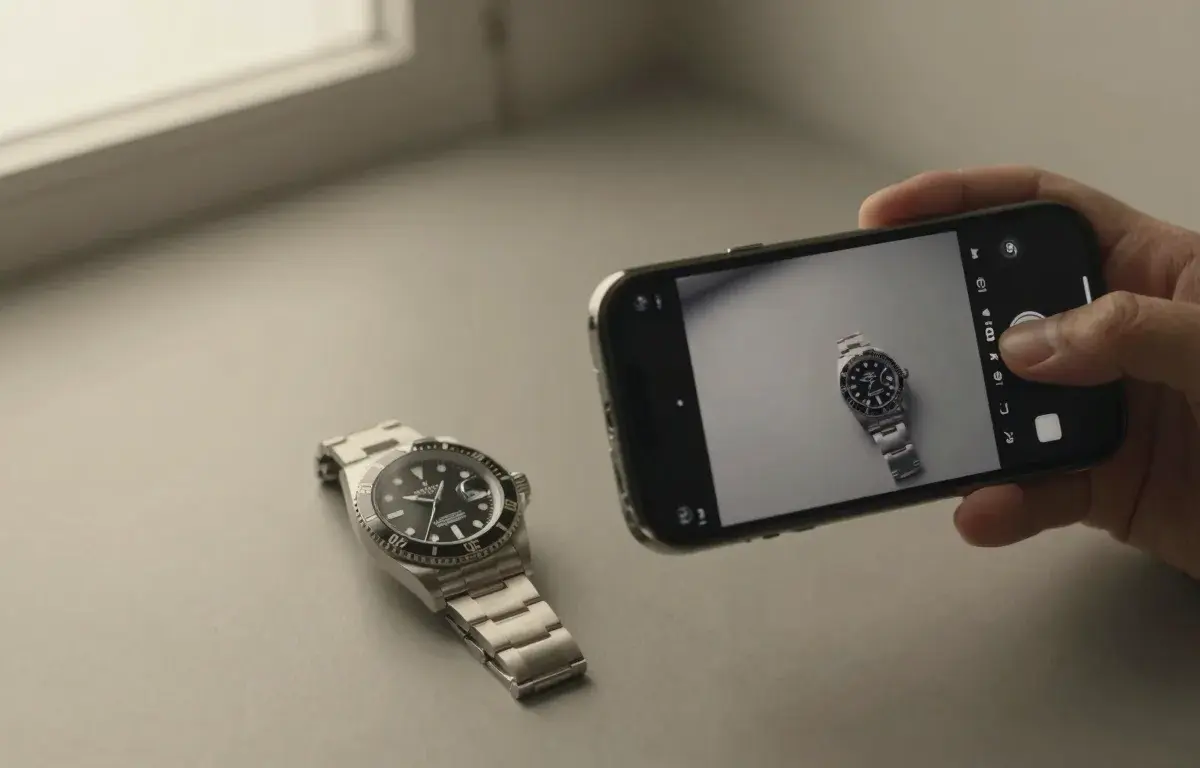
The fastest way to spot a fake Rolex is the second hand: a real one sweeps smoothly, most fakes tick. Weight, cyclops, and rehaut checks confirm it.
Watch the second hand first
A real Rolex second hand does not tick. The movement beats eight times per second, so the hand appears to glide around the dial in one continuous sweep. Most fakes use cheap quartz movements that jump once per second, and that single detail kills more counterfeits than any other check.
Hold the watch at eye level and follow the hand between two markers. If it stutters in one-second jumps, walk away. If it sweeps, you have ruled out the cheap tier of fakes, but not the expensive tier.
Here is the honest caveat. Better replicas now use automatic clone movements that also sweep. In my years checking listings, the sweep test filtered out roughly half of the fakes I saw, and the other half needed the checks below. Treat a smooth sweep as permission to keep inspecting, not as proof.
Feel the weight and the crown
A genuine Rolex is heavy for its size. A modern Submariner on a steel bracelet weighs around 150 grams. Rolex machines its cases and links from solid 904L stainless steel, a denser alloy than the 316L most fakes use, and many counterfeits go further and hollow out the bracelet links to save cost.
Pick the watch up and let the bracelet drape over your fingers. Hollow links feel light and rattly, and the bracelet folds like a cheap chain. Solid links feel dense and articulate with a smooth, damped motion.
Then unscrew the crown. On a real Rolex the threading is precise, the crown releases with a clean pop, and winding feels smooth with slight resistance. Fakes often have gritty threading, wobble in the crown stem, or a crown logo that is flat and poorly defined.
Test the cyclops date magnification
The cyclops lens above the date should magnify it 2.5 times. On a genuine watch the date numeral fills almost the entire bubble. Most fakes use a flat or weak lens closer to 1.5x, so the date sits small inside the lens with empty space around it.
Look straight down at the date, then tilt the watch. Genuine magnification stays strong and the numeral stays centered in the window. Check the date font too. Rolex numerals are crisp, evenly inked, and perfectly centered. Fuzzy edges, off-center digits, or a date that sits low in the window are all bad signs.
One more detail worth knowing. On recent models Rolex applies anti-reflective coating to the underside of the cyclops, so the date stays readable at odd angles. Fakes with uncoated lenses throw noticeably more glare.
Photograph the item and Legit Check runs these same checks in seconds, returning a confidence score and the reasoning behind it.
Read the dial like an authenticator
Dial printing is where counterfeits leak the most. Under a 10x loupe, genuine Rolex text is sharp, sits slightly raised off the dial, and is evenly spaced. Fake printing tends to be flat, slightly blurry at the edges, or inconsistent in weight between lines.
Look at the coronet, the five-point crown logo at 12 o’clock. On a real watch the points are evenly spaced and the base is well defined. Fakes often get the proportions subtly wrong: too fat, too flat, or asymmetrical.
Check the lume plots on the hour markers. Genuine lume is applied evenly and glows uniformly after a bright light hits it. Sloppy, grainy, or uneven lume is a common counterfeit tell.
Since around 2002 Rolex also laser-etches a tiny coronet into the crystal at 6 o’clock. It is nearly invisible head-on and takes angled light and a loupe to see. Good fakes now copy it, so its absence is a stronger signal than its presence.
Dial work is also where photo-based AI earns its keep. Fonts, coronet geometry, and lume application are hard to describe in words but easy to compare against a reference set, and that is what Legit Check does when you photograph the dial: it weighs those visual signals against known genuine examples and explains its reasoning instead of handing you a bare verdict.
Verify the serial and rehaut engraving
Modern Rolexes engrave the serial number on the rehaut, the inner ring between the dial and the crystal, at the 6 o’clock position. The word ROLEX repeats around the rest of the ring. On a genuine watch this engraving is machine-perfect: evenly deep, evenly spaced, and aligned so precisely with the dial minute markers that it looks printed.
Fakes get the rehaut wrong in predictable ways. The lettering is often acid-etched rather than engraved, so it looks fuzzy or gray instead of sharp and metallic. Spacing drifts, letters lean, and the alignment with the dial is off by a marker or two.
On watches made before roughly 2005 the serial sits between the lugs at 6 o’clock, hidden behind the bracelet end link. You need to slide the end link or remove the bracelet to see it. Deep, sharp stamping is genuine. Shallow, sandy-looking numbers are not.
A word of caution. Serial numbers alone prove little, because counterfeiters copy real serials onto fake watches. A serial that matches a plausible reference tells you the number is realistic, not that the metal in your hand is genuine.
Bracelet, clasp, and paperwork
Flip the clasp open and look inside. Genuine clasps carry a crisp coronet, clean brushed and polished finishing, and stamped markings with sharp edges. The mechanism closes with a solid, confident snap. Fake clasps feel tinny, show rough edges inside, and the engraving is often shallow.
On sports models with a Glidelock or Easylink extension, run the adjustment. Genuine systems move in precise, damped increments. Counterfeit versions bind, scrape, or feel loose.
Paperwork helps less than people think. Warranty cards, boxes, and receipts are all counterfeited, and genuine papers get sold separately to be paired with fake watches. Treat papers as a small plus, never as proof. If you want certainty at purchase, buy through Rolex’s network of official retailers, listed on rolex.com, or through a secondary dealer who puts an authenticity guarantee in writing.
My 60-second routine before any deal
That routine catches the cheap and mid-tier fakes, which is most of what circulates in marketplace listings. Superfakes are a different problem. They pass the sweep, the weight, and sometimes the rehaut, and they are the reason no serious buyer relies on one check alone. The same layered approach runs through all the watch guides on this site, and the logic carries to other categories too, the same way hardware and stitching give away a fake Louis Vuitton bag.
For a four-figure purchase I layer two things: an AI pre-check with Legit Check on the seller’s photos before I commit to anything, then a professional authenticator with the watch in hand before money moves. The app read tells me whether the listing is worth pursuing and flags which details look off. The professional opens the caseback and confirms the movement, which is the one thing photos cannot show.
Frequently asked questions
Legitly offers AI-assisted guidance, not guaranteed authentication. For high-value purchases, confirm with a professional authenticator.