The fastest way to spot a fake soccer jersey is to look at the crest, the jock tag, and the heat-applied badges. Fakes fail at least one of those three within a minute of handling. I checked thousands of jerseys during my years reviewing marketplace listings, and this guide walks through the seven checks I still run on every Mexico, club, and national team kit.
Start With the Crest
The crest is where most fakes fall apart first. Official club and national crests are either densely embroidered or applied as a clean heat-transfer badge, depending on the kit year and version. Counterfeit embroidery tends to be thin, with backing fabric visible between stitches and threads that lift at the edges.
Look at the color separation inside the crest. Genuine crests keep sharp borders between colors, even in tiny details like stars, laurels, and lettering. Fakes bleed at the boundaries because counterfeit factories run lower stitch counts with fewer thread colors.
Then flip the shirt inside out. A real embroidered crest shows tidy, even stitching on the reverse with proper backing fabric. A loose nest of threads behind the crest is one of the most reliable fake tells I know.
If you want more apparel guides built the same way, the streetwear section covers hoodies, jackets, and caps.
Check the Jock Tag and Product Code
The jock tag is the small brand tag sewn or heat-pressed near the bottom hem, usually on the front left. Nike, adidas, and Puma all use one, and it carries a product code you can verify.
Take that code and search it on the brand’s own site or an authorized retailer. The result should match the exact shirt in your hands: same team, same season, same colorway. A code that returns a different product, or nothing at all, is a serious warning sign.
Fakes often reuse one product code across an entire counterfeit production run. I have seen the same code on a Mexico home shirt, an Argentina away shirt, and a Real Madrid third kit in the same week of listings.
Also check how the tag is attached. Heat-pressed jock tags on genuine shirts sit flat with no bubbling at the corners. Peeling corners after light wear point to cheap adhesive.
Counterfeit apparel is one of the most seized product categories at the border, according to U.S. Customs and Border Protection. That volume explains why even reputable-looking marketplace sellers can carry fakes without knowing.
Read the Fabric and Stitching
Official match and fan shirts use engineered performance fabric. It feels light, slightly textured, and wicks moisture. Fakes tend to arrive in flat, shiny polyester that feels like a budget training shirt and traps heat.
Check the ventilation zones. Many genuine kits use different knit structures under the arms and down the sides. Counterfeits print a mesh pattern instead of knitting one, so the vents feel identical to the rest of the shirt.
Run your fingers along the hems and sleeve cuffs. Genuine shirts finish with even, tight stitching and consistent thread tension. Skipped stitches, wavy hems, and loose threads at the seams show up constantly on fakes because the shirts are sewn fast and cheap.
Compare the wash label to the jock tag last. Size, country of manufacture, and fabric composition should be consistent across every label in the shirt. A neck label and a wash label that disagree on size end the debate on the spot.
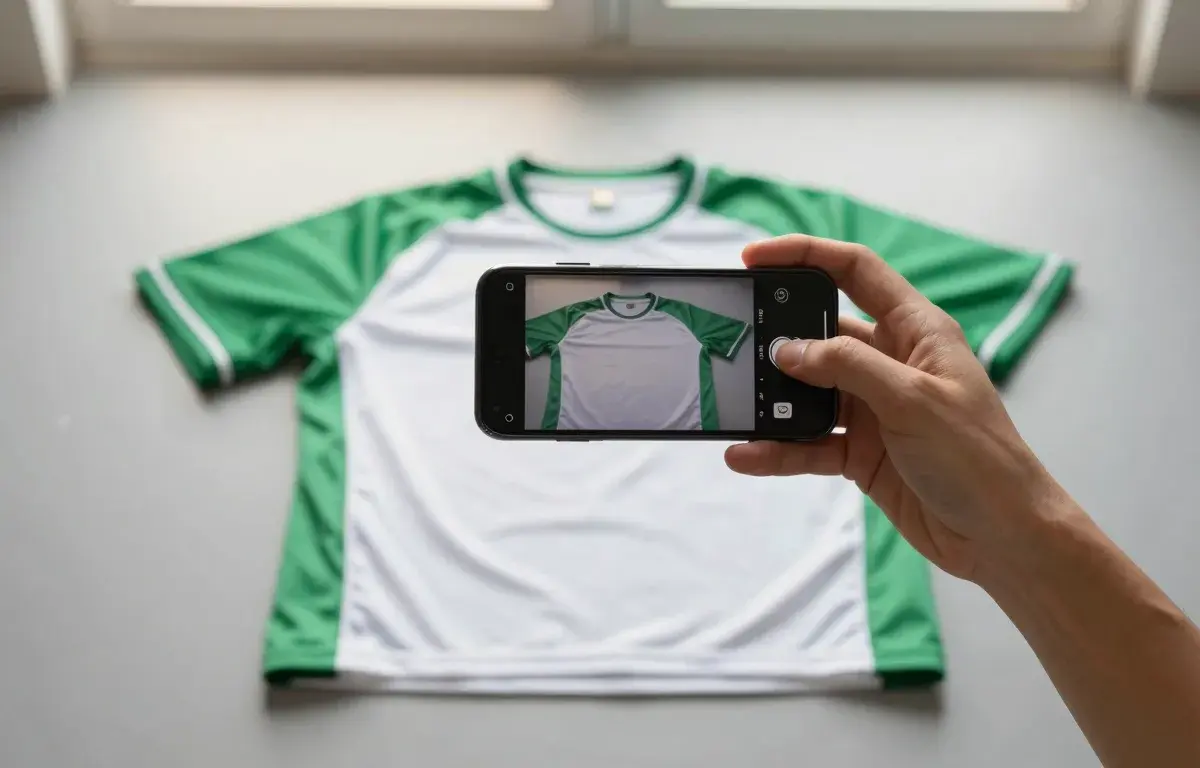
Photograph the item and Legit Check runs these same checks in seconds, returning a confidence score and the reasoning behind it.
Verify the Authentication Tag or QR Code
Most modern shirts carry a second layer of verification beyond the jock tag. Adidas sews a small code label into the side seam, and many recent kits add a QR code that resolves to the brand’s own domain. Nike prints unique product identification on the internal labels.
Scan any QR code and read the URL before you trust it. It should land on the brand’s official site, not a lookalike domain. Counterfeiters have started printing QR codes that lead to convincing clone pages, so the destination matters more than the presence of a code.
Official league and tournament badges add another check. Licensed Premier League, Champions League, and World Cup badges come from official suppliers with distinctive texture and precise detail. Flat, sticker-like badges with fuzzy printing are a common shortcut on fakes.
Reading crest, badge, and label signals from photos is the exact problem Legit Check was built to handle. You photograph the shirt and the AI returns a real-or-fake reading with a confidence score and the reasoning behind it, which beats guessing when a listing only gives you four photos.
Mexico Jerseys: What Fakes Get Wrong
Mexico kits are among the most counterfeited national team shirts in North America, and I saw them weekly during marketplace review. The federation crest is the pressure point. The eagle detail in the badge needs fine embroidery or precise printing, and fakes soften or distort it.
Study the details inside the crest at close range. Genuine badges keep the eagle, the lettering, and the border geometry crisp. On fakes the eagle looks smudged, the green shade drifts, and the circular border thickens unevenly.
Adidas has made Mexico’s kits for decades, so every genuine shirt follows standard adidas construction. That means a proper jock tag, a sewn-in code label, and a product code that resolves to a Mexico kit. A Mexico shirt with another brand’s labeling style is wrong on its face.
Retro Mexico shirts deserve extra caution. The 1998 kit and other vintage designs are heavily reproduced, and some sellers describe reprints as originals. On vintage listings, ask for the wash label and the reverse of the crest before you pay anything.
Player Version vs Fan Version Confusion
Brands sell two builds of most kits. The fan version uses standard fabric, embroidered or textured crests, and a regular cut. The player version, often sold as authentic, is lighter, slimmer, and uses heat-bonded details to save weight.
Counterfeiters blur these lines constantly. A common fake pattern is a shirt sold as a player version with an embroidered crest, standard fabric, and a fan-version cut. Genuine player versions of recent kits use heat-applied crests and badges, not embroidery.
Check the seams too. Many player versions use bonded or taped seams in place of visible stitching in key areas. If a listing claims player issue and the photos show ordinary overlock stitching everywhere, the label and the shirt disagree.
Price gaps make this check worth your time. Player versions retail well above fan versions, so a fake labeled as an authentic player version carries the biggest markup for the counterfeiter and the biggest loss for you.
Price, Seller, and Listing Red Flags
New official kits hold their price. A current-season national team shirt listed new for a third of retail is not a deal, it is a signal. Genuine clearance exists, but it happens at known retailers, not from a seller with twelve identical shirts in every size.
Read the listing itself. Stock photos only, every size from S to XXL available, and shipping from an overseas warehouse form a familiar pattern. Ask for photos of the jock tag, the wash label, and the reverse of the crest. Sellers holding a real shirt send them in minutes.
Check the seller’s history for repetition. Accounts moving dozens of new-with-tags jerseys across many clubs at once are often reselling from counterfeit wholesalers, sometimes without knowing it themselves.
For anything above ordinary fan-shirt money, like match-worn or vintage pieces, stack your checks. Run an AI pre-check with Legit Check first, then bring in a professional authenticator before serious money moves. You can read how the app approaches this on our how it works page.
Frequently asked questions
Legitly offers AI-assisted guidance, not guaranteed authentication. For high-value purchases, confirm with a professional authenticator.